
Every year, approximately 350,000 Americans experience out-of-hospital cardiac arrest. Yet, despite this staggering number, only about 40% receive immediate help before professional responders arrive. This gap represents thousands of lives that could be saved through proper CPR training and immediate action. Mastering chest compressions stands as the single most critical skill in emergency cardiac care.
Understanding CPR and Chest Compressions: What’s the Difference?
Many people wonder if chest compressions and CPR are the same thing. The answer requires clarification. CPR, or Cardiopulmonary Resuscitation, encompasses a broader set of lifesaving techniques. CPR is an emergency lifesaving procedure performed when the heart stops beating. It includes chest compressions as its foundation, but also incorporates rescue breathing and, when available, automated external defibrillator (AED) use.
Chest compressions form the core component of CPR. They work by manually pumping blood through the heart, creating artificial circulation when the heart has stopped. Think of compressions as the engine that drives the entire CPR process. Without them, oxygen cannot reach vital organs, particularly the brain.
Mastering Chest Compressions: The Foundation of Survival
Recent data underscores why mastering chest compressions matters so profoundly. Immediate CPR can double or triple chances of survival after cardiac arrest. The 2025 American Heart Association Guidelines emphasize that high-quality chest compressions remain essential for improving survival rates and neurological outcomes.
Research from the Cardiac Arrest Registry reveals compelling evidence. People who received CPR within two minutes had an 81% greater chance of surviving and being discharged from the hospital. Even when started within 10 minutes, bystander CPR still provided a 19% higher survival rate compared to no intervention.
What Are the Correct Chest Compressions for CPR?
Mastering chest compressions requires understanding precise technique. The 2025 American Heart Association Guidelines provide clear specifications for effective compressions.
Proper Compression Technique
For adults experiencing cardiac arrest, rescuers should perform compressions with specific parameters. Rescuers should perform chest compressions at a rate of 100 to 120 per minute and to a depth of at least 2 inches (5 cm) for an average adult. However, excessive depth beyond 2.4 inches (6 cm) should be avoided as it can cause unnecessary injuries.
Here’s how to execute proper compressions:
Position yourself correctly. Kneel beside the person at chest level. Place the heel of one hand in the center of their chest, between the nipples. Place your second hand on top of the first, interlacing your fingers.
Maintain proper posture. Keep your shoulders directly above your hands. Lock your elbows to keep your arms straight. This positioning allows you to use your body weight effectively rather than relying solely on arm strength.
Push hard and fast. Compress the chest straight down at the specified rate and depth. After each compression, allow the chest to fully recoil. This recoil allows blood to flow back into the heart between compressions. Avoid leaning on the chest between compressions.
Minimize interruptions. Continue compressions with minimal pauses. The guidelines emphasize the importance of high-quality chest compressions with minimal interruptions. Every second without compressions reduces survival chances.
Mastering Chest Compressions: Quality Over Quantity
Research reveals that compression quality significantly impacts outcomes. Studies analyzing over 10,700 patients found improved survival when compression depth reached at least 5 cm compared to less than 4 cm. However, compressions exceeding 6 cm showed reduced survival rates, highlighting the importance of precision in mastering chest compressions.
Is It 15 or 30 Compressions for CPR?
A common question concerns the correct compression-to-breath ratio. The answer depends on who is performing CPR and the circumstances.
The 30:2 Ratio: Current Standard for Mastering Chest Compressions
For trained rescuers performing CPR on adults and children, deliver 2 rescue breaths after every 30 compressions. This 30:2 ratio represents the current standard established by the American Heart Association.
The sequence works as follows:
- Perform 30 chest compressions at the proper rate and depth
- Open the airway using the head-tilt, chin-lift method
- Deliver 2 rescue breaths, each lasting about one second
- Watch for visible chest rise with each breath
- Immediately resume compressions
This cycle continues until the person shows signs of life, an AED becomes available, or trained medical personnel arrive.
Special Circumstances in Mastering Chest Compressions
Drowning victims require modified approaches. Trained rescuers should initiate CPR by giving two rescue breaths followed by 30 chest compressions when someone is pulled from water. This reversal prioritizes oxygenation for drowning victims, as their cardiac arrest stems from oxygen deprivation rather than a primary heart problem.
Hands-Only CPR: An Alternative for Bystanders
For untrained bystanders or those uncomfortable with rescue breathing, hands-only CPR provides an effective alternative. Hands-Only CPR is recommended for use by people who see a teen or adult suddenly collapse in an out-of-hospital setting. This approach focuses exclusively on continuous chest compressions without rescue breaths.
The 2025 Guidelines continue emphasizing compression-only CPR for untrained bystanders during out-of-hospital cardiac arrests. By eliminating rescue breaths, bystanders are empowered to act quickly without hesitation. Research demonstrates that early, high-quality compressions prove critical to maintaining blood flow during the first crucial minutes.
The Science Behind Mastering Chest Compressions
Understanding the physiology helps reinforce proper technique. Chest compressions generate artificial circulation through two mechanisms. First, they increase intrathoracic pressure, which compresses the heart and propels blood forward. Second, they create a pressure gradient that drives blood flow to vital organs.
Effective compressions maintain coronary perfusion pressure. This measurement represents the difference between aortic diastolic and right atrial diastolic pressure during the relaxation phase between compressions. Coronary perfusion pressure remains crucial for myocardial blood flow and serves as a primary determinant of successful return of spontaneous circulation.
Why Timing Matters in Mastering Chest Compressions
The urgency of starting CPR cannot be overstated. Survival chances decrease by 10% for every minute that immediate CPR and use of an AED is delayed. This dramatic decline emphasizes why mastering chest compressions and acting immediately saves lives.
Research tracking nearly 200,000 witnessed cardiac arrests demonstrated clear survival gradients. Those receiving CPR within two minutes showed dramatically better outcomes than those receiving it later. However, even CPR started within 10 minutes provided measurable benefits compared to no intervention at all.
After 10 minutes without CPR, survival chances drop to levels equivalent to receiving no CPR at all. This stark reality underscores the critical importance of immediate action and widespread CPR training.
Mastering Chest Compressions: Training and Certification
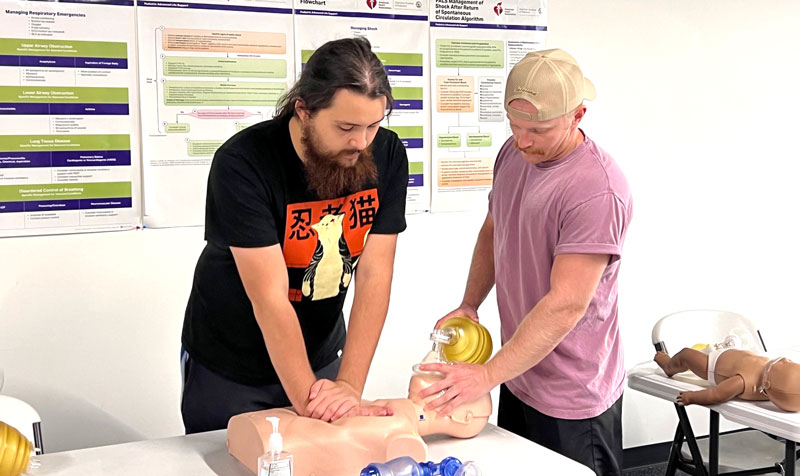
While this guide provides essential information about mastering chest compressions, nothing replaces hands-on training. Formal CPR certification ensures you can perform high-quality compressions under pressure, recognize when to start CPR, and coordinate effectively with other rescuers.
Professional training addresses several critical elements not fully captured in written descriptions:
Hands-on practice allows you to feel the correct compression depth and rate. Instructors provide real-time feedback on your technique, helping you develop muscle memory that proves invaluable during actual emergencies.
Scenario-based learning prepares you for the stress and uncertainty of real cardiac arrests. You’ll practice recognizing cardiac arrest, calling for help, and coordinating care with other responders.
Regular recertification keeps your skills sharp and ensures you stay current with evolving guidelines. The American Heart Association updates its recommendations based on the latest research, making ongoing education essential.
Take Action: Get Certified in CPR and Chest Compressions Today
Mastering chest compressions represents one of the most valuable skills you can acquire. The statistics paint a clear picture: cardiac arrest strikes hundreds of thousands of Americans annually, yet survival to hospital discharge after EMS-treated adult cardiac arrest was only 10.5% in recent data. However, when bystanders initiated CPR, survival rates jumped to 13.0%.
You have the power to change these statistics. By mastering chest compressions through professional training, you join a community of lifesavers making a tangible difference in their communities.
Don’t wait until an emergency strikes. Take the first step toward mastering chest compressions and become the person who can act when seconds count. Your training could mean the difference between life and death for someone you love.
Ready to master chest compressions? CPR Nashville, an American Heart Association training site, offers comprehensive CPR certification in Nashville and BLS certification in Nashville. Our stress-free, hands-on courses cover BLS for Healthcare Providers, ACLS, PALS, and CPR and First Aid. Whether you need initial certification or renewal, our expert instructors ensure you master the techniques that save lives.
Contact CPR Nashville today and gain the confidence and skills to respond effectively when every second matters. Your community needs prepared responders—become one of them through proper training in mastering chest compressions and comprehensive CPR techniques.